September 2026

|
This is a young grey langur. The Semnopithecus is a genus native to the Indian subcontinent. These monkeys spend half their time on the ground and the other half on trees. They are primarily herbivores with non-plant food being some insects. They have a very rich social structure which cannot be described in such a short space! Interesting monkeys.
By Hkms - Own work, CC BY-SA 4.0, https://commons.wikimedia.org/w/index.php?curid=55645422
|
August 2026

|
"God has an inordinate fondness for beetles" is a quote attributed to J.B.S. Haldane. There are so many species of beetles that 25% of all known animal species are beetles! Pictured here is a male European rhinoceros beetle. There are over 1500 species of rhinoceros beetles, found pretty much across the world. They are large, harmless, with a thick exoskeleton and they can fly (though not very well because of their size). Among all the beetles, I think these are my favourite and it partly has to do with a Pokemon named Heracross which created an impression on a young me.
By George Chernilevsky - Own work, Public Domain, https://commons.wikimedia.org/w/index.php?curid=19885947
|
July 2026
|
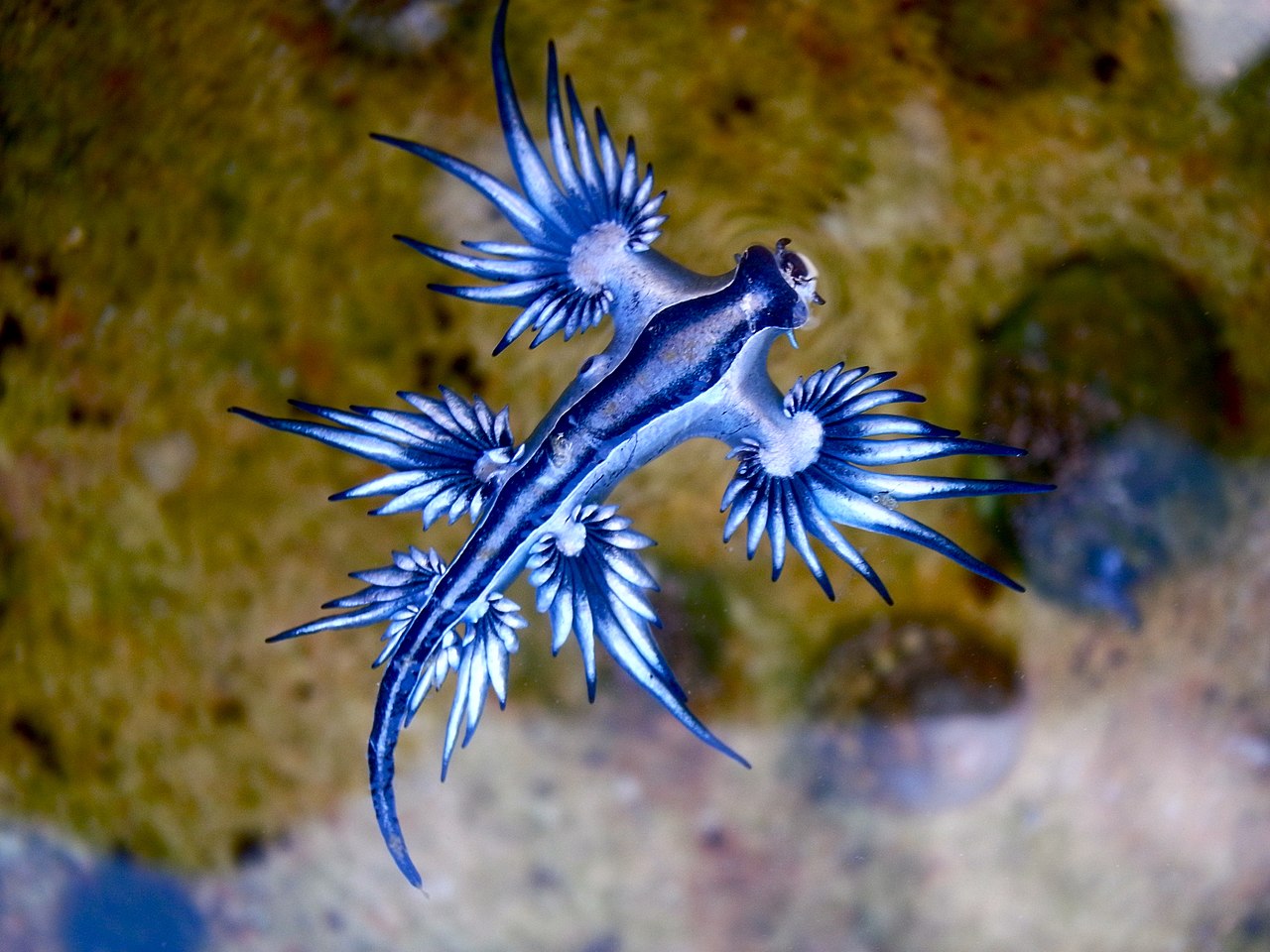
This is a blue sea dragon (according to the description, this was washed ashore). It is a nudibranch (Latin for naked gills) and is a sea slug. Nudibranches are known for their striking colours. This particular species floats in the open ocean (upside down because its stomach has a gas bubble to aid with the floating), carried by the currents and feeds on other similar open ocean travellers. It is about 3cm in size and is believed to be found throughout the world's oceans thriving in warm waters. If you happen to come across a beached blue sea dragon, don't touch it for it can give you a painful sting and a bunch of nasty symptoms. But how colourful they look!
By Sylke Rohrlach from Sydney - Blue dragon-glaucus atlanticus, CC BY-SA 2.0, https://commons.wikimedia.org/w/index.php?curid=39934058
|
.jpg)
June 2026

|
A for aardvark. I first learnt of this curious creature from an old cartoon back in the day. Found across Africa, they spend their days in dark burrows to avoid the heat. They mainly feed on ants and termites. They emerge from their burrows after sunset and start foraging for ants and termites making sure to not repeat their routes for 5-8 days so that termite mounds can recover. Smart! Old aardvark burrows are used by other animals and birds and this protects them during wildfire seasons. Fascinating creatures!
By Kelly Abram - https://www.inaturalist.org/photos/175359469, CC BY 4.0, https://commons.wikimedia.org/w/index.php?curid=134253363
|
May 2026

|
This is a southern three banded armadillo. Despite the name of this site, this is the first time I'm posting an armadillo picture. When choosing the name, I only wanted something that had a nice rhyme and rhythm. There are 21 species of armadillos and they all have a leathery armour shell composed of keratin. The two species in the genus Tolypeutes are the only ones that curl up into a ball when threatened (the others can't because they have too many plates!). Native to the Americas, armadillos are threatened by habitat loss and climate change.
By Hedwig Storch - Own work, CC BY-SA 3.0, https://commons.wikimedia.org/w/index.php?curid=27702770
|
April 2026

|
March was quite long, wasn't it? This is a picture of petroleum. Society is in a bit of trouble regarding this magical liquid right now. Before life learned to "digest" dead organic matter, all the dead plankton, algae and other organisms decomposed anaerobically turning into petroleum. This happened 252-66 million years ago. Humans started using petroleum in one form or another at least 4000 years ago, but it wasn't until the 19th century that we started to rely on it so much - first for lighting, then everything else.
By Nefronus - Own work, CC0, https://commons.wikimedia.org/w/index.php?curid=94983250
|
March 2026

|
Last month's picture was that of a frill-necked lizard. This month we have the skull of a triceratops, a genus of dinosaurs that had 3 horns and a large bony frill. In nature, frills come in two types: bony and cartilaginous. Today bony frills are found in horned lizards. The usage of frills in dinosaurs is poorly understood but it may have been used for thermoregulation or for defense. It is suspected that during territorial fights, triceratops may have used their bony neck frills as shields. There were other dinosaurs with similar large bony neck frills. What a sight it would have been to see these frilled dinosaurs roaming in the wild!
By Marsh, O.C. (1896). "The dinosaurs of North America." Sixteenth Annual Report of the United States Geological Survey, pp. 133-244. Washington: Government Printing Office, 1896. - http://www.lindahall.org/events_exhib/exhibit /exhibits/dino/mar1896.shtml, Public Domain, https://commons.wikimedia.org/w/index.php?curid=514745
|
February 2026

|
This majestic creature is the frilled lizard. It is native to northern Australia and southern New Guinea. From head to tail they can be as long as 90cm and weigh 600g! The frill is used to make it appear larger and more threatening to predators and when fully extended it can be almost 30cm in diameter. They spend most of their time on trees and are more active during the wet seasons feeding mainly on insects. These curious creatures are fast runners and are capable bipedal runners. I find their frills very majestic and royal looking. I learnt about frilled lizards from the same book I mentioned in last month's picture.
By Matt from Melbourne, Australia - Frill-necked Lizard (Chlamydosaurus kingii)Uploaded by SunOfErat, CC BY 2.0, https://commons.wikimedia.org/w/index.php?curid=27543058
|
January 2026

|
This is a picture of a Philippine Tarsier. Tarsiers are named after their long tarsus bones, but the feature that captures our eyes are their eyes. Their eyes have an average diameter of about 16mm which is comparable to that of a new born human's eyes. Their eyes are as large as their brains, sometimes larger! They have the largest eye-to-body weight ratio of all mammals. They can also turn their heads 180° in either direction (because they cannot move their eyes).
Tarsiers are nocturnal and mainly feed on insects. They are shy, reclusive and do not do well under stress or captivity. In the wild, they can live up to 24 years! I came to know about tarsiers in a book about animals when I was much younger and have been fascinated ever since.
By mtoz - originally posted to Flickr as Tarsier, CC BY-SA 2.0, https://commons.wikimedia.org/w/index.php?curid=3814411
|
December 2025

|
This is a picture of an Arctic tern hovering over its nest with some food in its mouth. Arctic terns are most famous for their migration - on average they fly 48,700-70,900km, annually! Every year, they enjoy two summers (it is freezing here in MN, brrr).
They mostly live on fish, crabs and the like. They mate for life and return to the same colony each year, and both sexes share incubation duties. During the southern summer (i.e., right now) they can be seen as far south as the edges of Antarctica. They can live up to 30 years, which means they might travel 2.4 million kms - equivalent to flying to the moon and back more than three times!! There are many more things I want to say, but alas this space is too short. Along with the linked Wikipedia page, check out this article.
By Charles J. Sharp - Own work, from Sharp Photography, sharpphotography.co.uk, CC BY-SA 4.0, https://commons.wikimedia.org/w/index.php?curid=175107313
|
November 2025

|
"Picture of the month" is now 3 years old. How time flies! This is a picture of a
|
October 2025

|
This is a scanning electron microscope photo of a citrus yellow mite. Mites are minute creatures, most being less than 1mm in size. The yellow mite in particular is generally less than 250 micrometers in size. That's tiny! These mites are usually found in citrus plants and they have a lifespan of about 37 days. Their lifecycle has about 6 stages, and they reproduce by a strange way called thelytoky, a form of reproduction without mating. Some mites are pests, but these aren't. I think it's amazing that such tiny creatures exist and that we can take such beautiful pictures.
By Photo by Eric Erbe; digital colorization by Chris Pooley.Edited by Fir0002 - This image was released by the Agricultural Research Service, the research agency of the United States Department of Agriculture, with the ID K9077-22 (next)., Public Domain, https://commons.wikimedia.org/w/index.php?curid=130148
|
September 2025

|
The Indian palm squirrel, a very common site back home. I don't have much to say. They are cute but noisy at times, and back home last month a squirrel gave birth to a litter of three and all three successfully left the nest.
By Yathin S Krishnappa - Own work, CC BY-SA 3.0, https://commons.wikimedia.org/w/index.php?curid=26945017
|
August 2025

|
This is a closeup picture of the wing of a leaf hopper. How did it get those colours? The wing is composed of chitin. Chitin is the second most abundant polysaccharide (first being cellulose) and is used in a modified form by most arthropods.
When modified chitin gives a strong shell to most insects. In butterfly wings, stacks of gyroids made of chitin come together to create brilliant colours via thin film interference. This is one subtype of structural colouration, and as an example, have a look at the wings of the Morpho butterfly.
It turns out that blue is a very rare pigment in nature and most of the blue we see (in flowers, insects, birds etc.) is often the result of the physics of light! Usually colours work by complementary absorption.
By Zituba, CC BY-SA 3.0, https://commons.wikimedia.org/w/index.php?curid=9021403
|
_KL.jpg)
July 2025

|
An Indian peacock shows off its brilliant plumage. To quote Darwin, the peacock might be "the most splendid of living birds" and I think we can all agree on that. There are two hypothesis on the evolution of these feathers: one is simply an attraction to the colours, another is the handicap principle which says that brighter, larger secondary characteristics, such as these feathers, indicate a fitter individual because non-fit ones couldn't afford them.
The colours are not mainly due to pigments but due to optical effects from the nanostructures in the feather (see iridescence) and is a fascinating subject on its own.
Here's a new word: peacocks are Gallinaceous birds. There is another species in the same genus - the Green peafowl, native to the tropical forests of Southeast Asia.
By Jatin Sindhu - Own work, CC BY-SA 4.0, https://commons.wikimedia.org/w/index.php?curid=49736189
|
June 2025

|
This is a mountain tapir (pronounced tay-per). There are 4 recognized species of tapirs and this one is found only in a small region of the Andes. It is the smallest tapir species, has a thick wooly coat and white lips (and this is the first time I've ever thought about the lip colours of animals).
A distinctive feature of tapirs is their nose-trunk. It is flexible, can move in all directions and is made up entirely of soft tissue. I thought they might be related to elephants, but turns out they are more related to rhinos and horses than elephants.
The mountain tapir roams between cloud forests and paramos between seasons. With the loss of habitat, among other threats, they are now an endangered species (but sadly, their population may have already fallen below the level needed to sustain genetic diversity).
By desertnaturalist - https://www.inaturalist.org/photos/133820375, CC BY 4.0, https://commons.wikimedia.org/w/index.php?curid=137305167
|
May 2025

|
This is a picture of an elephant, specifically, the African bush elephant. But what I really want to highlight is the elephant trunk. It is pure muscle, very little fat and no bones. There are more muscles in the elephant trunk than there are in the human body! It can lift up to 350kgs but can also crack a peanut shell without breaking the peanut. Using their trunk, elephants can reach for things up to 7m high and dig the ground!
It is awesome as a nose too - able to siphon water, useable as a snorkel when swimming and has an amazing sense of smell. An evolutionary marvel! Other things about the elephant that amuse me are their tusks, ears, ability to sense vibrations through their feet, their sheer size. What amazing creatures!
By Charles J. Sharp - Own work, CC BY-SA 3.0, https://commons.wikimedia.org/w/index.php?curid=30032867
|
April 2025

|
This is a picture of Saturn's moon Daphnis. It's about 8km in diameter and resides in the Keeler gap, a 42km wide gap in Saturn's A-ring. This moon was discovered in 2005, but it was inferred to exist before that because of its gravitational effects on the rings. As visible in this picture, as the moon orbits Saturn it pulls and tugs on the rings and this causes these ripples on the edges of the Keeler gap. Why ripples? Because the inner ring moves slightly faster than the moon and the outer one slightly slower - so the inner ripple moves ahead of the moon and the outer one lags behind. This is such a beautiful phenomenon in our solar system!
By NASA/JPL/Space Science Institute - This image or video was catalogued by Jet Propulsion Laboratory of the United States National Aeronautics and Space Administration (NASA) under Photo ID: PIA11653., Public Domain, https://commons.wikimedia.org/w/index.php?curid=7011875
|
March 2025

|
This is a stoat in its winter fur. It looks fluffy and cute. Stoat's belong to the same family as otters and weasels and such. Stoats are distributed across the Northern hemisphere and this white fur is seen in those subspecies that live further up North. There are 21 subspecies and they moult twice a year (the moulting process initiated by change in day length) and some of them go completely white (except for the ends of their tails) during the winter.
These creatures are carnivorous and when introduced in New Zealand to control rabbits, they quickly became one of the "top 100" worse invasive species! Interestingly, the stoat doesn't dig its own burrow, but uses the burrows of its prey. Sadly, their white fur used to be seen as a status of royalty.
By Mustela_erminea_winter.jpg: Steven Hintderivative work: Guerillero (talk) - Mustela_erminea_winter.jpg, CC BY-SA 3.0, https://commons.wikimedia.org/w/index.php?curid=14519034
|
February 2025
|
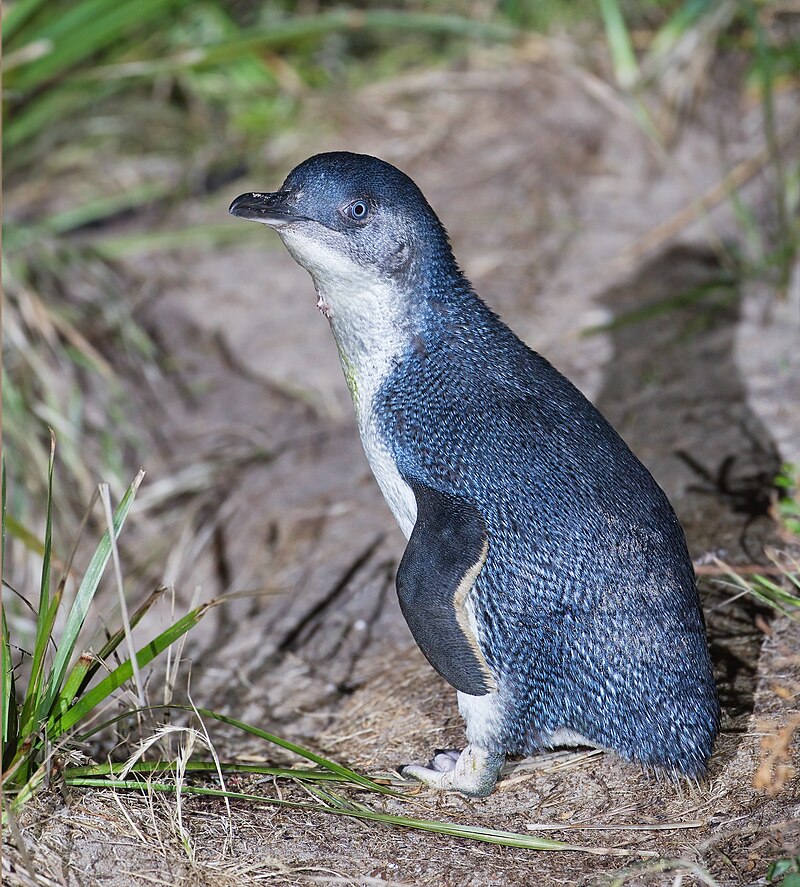
I think blue is one of the rarer colours to appear in plant and animal life. On the left is the Australian little penguin, also called the fairy penguin or blue penguin.
TThere are two species in the Eudyptula ("good little diver") genus. This species was (after initially being classfied as a species in 1826) reclassified as a subspecies of the other little penguin, but in 2016 (that's so recent!) was reclassified as its own species. Both species are found in Southern Australia and regions of New Zealand.
The penguins in this genus are the smallest of all penguins growing to be around 33 cm and weighing just 1.5kgs! They have a lifespan of about 6.5 years.
Among other differences, the species pictured has a more distinct blue colour compared to the other, and this is due to an abundance of melanosomes. How might such a beautiful blue penguin sound? Listen to this audio clip on the linked Wikipedia page.
By JJ Harrison (https://www.jjharrison.com.au/) - Own work, CC BY-SA 3.0, https://commons.wikimedia.org/w/index.php?curid=12200820
|
January 2025

|
This is the pappus of a dandelion, i.e., the white fluffy thing. It's attached to an achene, which is a dry fruit that contains the seed.
Disperesed by winds, they land wherever the wind takes them. But they are not completely "helpless"; it turns out that these structures have so evolved that they generate a vortex ring that stabilizes the travel and increases lift. That's so cool!
Even though they don't have control over the winds, they seem well prepared and leave only when they are ready to.
By PiccoloNamek at English Wikipedia - Own work (Transferred from en.wikipedia to Commons by Maksim.), CC BY-SA 3.0, https://commons.wikimedia.org/w/index.php?curid=528340
|
December 2024

|
On the left is a honey bee foraging on quince flower. When the temperature drops to about 10 °C, bees stop flying around and huddle around the queen maintaining the core temperature between 27 °C and 34 °C. During winter, they consume honey and the amount consumed depends on how long and severe the winter is. Fascinating! Note that honey bees don't hibernate, although there are solitary bees that do.
By Spring's Flowers - Own work, CC0, https://commons.wikimedia.org/w/index.php?curid=147352319
|
November 2024

|
Another year has passed and "Picture of the month" has turned 2. The Northern hemisphere is cooling and the leaves are changing colours. I wonder if the trees know how beautiful they look, but alas, beauty is in the eye of the beholder...or so it goes.
This year's winter has been particularly warm, partly due to climate change, and partly due to the El Nino event. In fact, this year has been so warm that for the first time in 130 years, Mount Fuji (the mountain in the picture) is without snow in November.
Autumn leaf color and Mount Fuji with snow seen from Lake Kawaguchi, Japan. By Alpsdake - Own work, CC BY-SA 4.0, https://commons.wikimedia.org/w/index.php?curid=52410453
|
October 2024

|
This is a picture of the Crab Nebula taken by the Hubble telescope. This nebula formed when a star exploded and lit the skies for 2 years between 1054 and 1056. When a star's core is not supported against gravity pulling it inwards, it collapses at about 23% the speed of light. In other words, if you were standing there, the ground would disappear at a significant fraction of the speed of light! What follows is a lot of nuclear and astrophysics that I don't understand, leading to the creation of heavier elements (which is the only way things like iron even come into existence) and depending on the mass of the collapsing star, we may get a neutron star, a black hole, or some other exotic cosmic object. Incomprehensible sense of size, scale and energy!
By NASA, ESA, J. Hester and A. Loll (Arizona State University) - HubbleSite: gallery, release., Public Domain, https://commons.wikimedia.org/w/index.php?curid=516106
|
September 2024
|
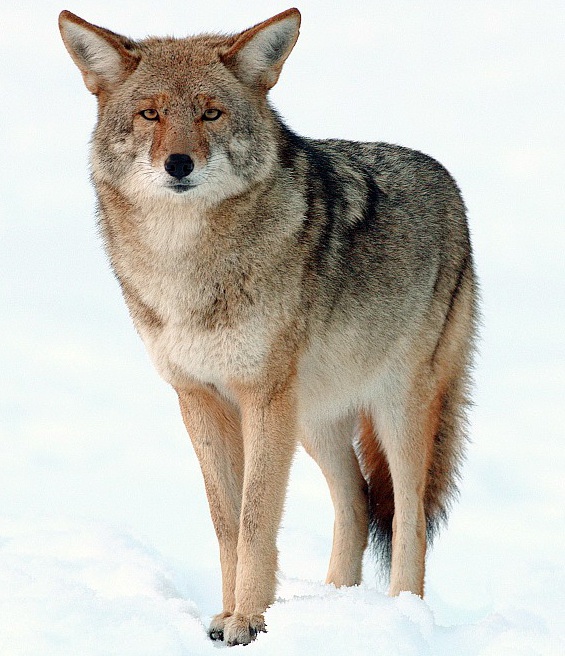
After last month's picture, I have to talk about the coyote. The linked Wikipedia page contains a lot of interesting information and other pictures. Coyotes were originally only found in the southewest North America and Mexico. With the extermination of wolves, they have spread across America, all theway to Alaska. In native american folktales, the coyote is depicted as a trickster. Unlike the cartoons, however, coyotes in real life don't spend their time constructing elaborate traps to hunt roadrunners.
By Yathin S Krishnappa - Own work, CC BY-SA 3.0, https://commons.wikimedia.org/w/index.php?curid=21284376
|
August 2024

|
This is a picture of the greater roadrunner running. The Looney Tunes cartoon is based on this bird. Found in the arid southwestern US and Mexico, this is a small bird in the cuckoo family. They are small birds with limited flight, 4 toes 2 pointing forward, 2 backward and can run up to 32kmph. Among its predators is the coyote. However, unlike the cartoon, it's not blue in colour. That's all for this month, beep beep.
By El Brujo+ - https://www.flickr.com/photos/jegomezr/2954808342/, CC BY-SA 2.0, https://commons.wikimedia.org/w/index.php?curid=7506391
|
July 2024

|
I was curious about what gave berries and grapes their colour. Pictured is the base unit of anthocyanidines. Anthocyanins are glycosides of this unit. What that means is that you take this molecule, replace most of the Rs with "-OH, -OCH3" molecules, but one of them (usually the third one) with a sugar molecule. Anthocyanins go from red in low pH conditions to blue in high pH.
It is these pigments that give the beautiful red, black, purple colours to berries, cherries, purple corn and more. There is another class of pigments called betalains that give the colour to beets and cacti. Interestingly, betalains and anthocyanins have never been found in the same plant.
By NEUROtiker - Own work, Public Domain, https://commons.wikimedia.org/w/index.php?curid=4507478
|
June 2024

|
This month's picture was going to be just the top of a pine cone (click here). Pine cones are the seed bearing parts of coniferous trees (usually). I think they look fantastic with their precise, mathematical patterns and they are woody and sturdy unlike flowers. While searching for a suitable picture, I came across this picture. It is the cone of a plant called Sclavo's cycad. Now cycads are not coniferous, although they do reproduce using cones. This species is found only in Tanzania, and grows to about 1m high. The pictured cone is about 45cm long. The sad part is that there are only 50 mature plants left. Cycads are very old and have been around for more than 65 million years, but are now in decline (I found this video informative).
By Muhammad Mahdi Karim - Own work, GFDL 1.2, https://commons.wikimedia.org/w/index.php?curid=10198765
|

May 2024
|
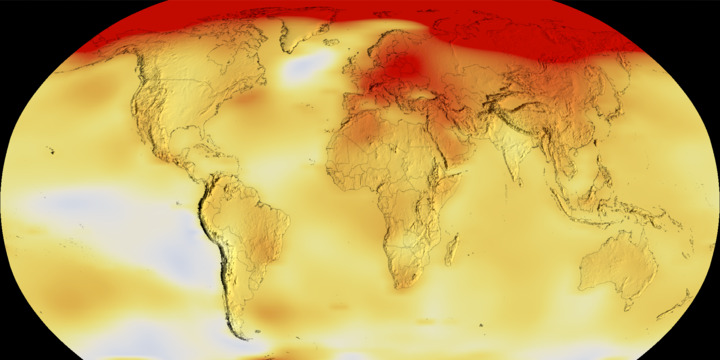
This is a screengrab of global average temperatures for the year 2022 from NASA's interactive climate change time machine (added Nov 2025 : website dead). As per the website,"This color-coded map shows a progression of changing global surface temperatures since 1884. Dark blue indicates areas cooler than average. Dark red indicates areas warmer than average."
I don't see any blue regions. There is currently a heat wave happening in India with temperatures reaching 40°C in some regions. I am hoping it is a consequence of El Niño rather than the grim reality of climate change that is just around the corner. This could be our new normal. In fact, it seems very unlikely that this won't be our new normal. Data source: NASA/GISS Credit: NASA's Scientific Visualization Studio |
April 2024

|
This is a bearded vulture, also called an ossifrage. It's the only known vertebrate whose diet is mostly bones! Vultures are scavengers, but this particular creature has evolved to only feed on bones. If the bones are too big, they carry it up into the air and drop it and repeat the process until the bone breaks (ossi=bone, frage=break) - this is something they learn over the course of their life. Sometimes they attack live animals and seem to favour tortoises. Can you guess how they break a tortoise's shell? I can only wonder why it evolved this way.
By Giles Laurent - Own work, CC BY-SA 4.0, https://commons.wikimedia.org/w/index.php?curid=142132355
|
March 2024

|
Time flies, huh. Well, February is the shortest month, even with a leap day. Did you know that you can know the age of some trees by counting the tree rings (you don't have to cut the tree, you can drill out a sample)? It's because as the tree grows, the type of bark it makes changes depending on the seasons. So you get an alternating pattern and counting those gives you how many years have passed. Of course, it's also because there's only one of each season every year (or is it the other way round?). It's not accurate, of course, because the same season can have different severity over the years. What you're actually looking at is the climate history that the tree has lived through! This is called dendrochronology.
By Arpingstone - Own work, Public Domain, https://commons.wikimedia.org/w/index.php?curid=447580
|
February 2024

|
This is a picture of Labord's chameleon. Amazingly, in certain arid regions of their habitat, these species have a lifespan of about 4-5 months: the eggs hatch during the wet season in November, they reach adulthood by January, then they deposit their eggs between late January and late March after which the entire species dies. Poof, just like that, and the cycle continues.
That's just evolution and this strategy seems to have worked for this species at this point in history.
By Christopher Raxworthy - National Science Foundation, Public Domain, https://commons.wikimedia.org/w/index.php?curid=9531941
|
January 2024

|
This graph shows the deviation of the global mean surface temperature (GMST) from the pre-industrial era. GMST is the average of surface temperatures recorded over land, sea and sea ice. We are currently about 1.2 °C above the pre-industrial average. The year 2023 was the warmest year ever recorded (although some of it can be due to El Niño) and it is quite likely that 2024 will be too. Even though the 2015 Paris Agreement promised to keep warming "well under 2 °C", we are on track to reach about 2.7 °C by 2100.
By Efbrazil - Own work, CC BY-SA 4.0, https://commons.wikimedia.org/w/index.php?curid=87410053
|
December 2023

|
This is a picture of a dragonfly eye! Definitely one of my top favourite insects. Did you know that dragonfly eyes have nearly 24000 "units" to sense light? It is believed that dragonflies see in slow motion because they see images at a much faster rate than humans do. They can see in all directions at once and nearly 80% of their brain is dedicated to sight.
These fascinating creatures are fast fliers and can propel themselves in all six directions! Blue skies and dragonflies: a merry treat for my eyes!
By Dustin Iskandar from Kuching, Malaysia - Big Eyes, CC BY 2.0, https://commons.wikimedia.org/w/index.php?curid=32535863
|
November 2023

|
The Pale Blue Dot has gone around the sun yet again since I started "Picture of the month". Much has happened and this is a reminder that time's precious. To sieze the day while we are still able to is the hope that drives us. Some days we are able to sieze while others slip through the fingers like dry sand on a deserted beach; deserted yet, like our lives, the susurration of waves is incessant - back and forth, giving and taking from the shore. So it goes.
On the left is Earth as seen from 6 billion kilometres away: it's the pale dot about half way up the rightmost band. By Voyager 1 - http://visibleearth.nasa.gov/view.php?id=52392, Public Domain, https://commons.wikimedia.org/w/index.php?curid=4400327 |
October 2023
|
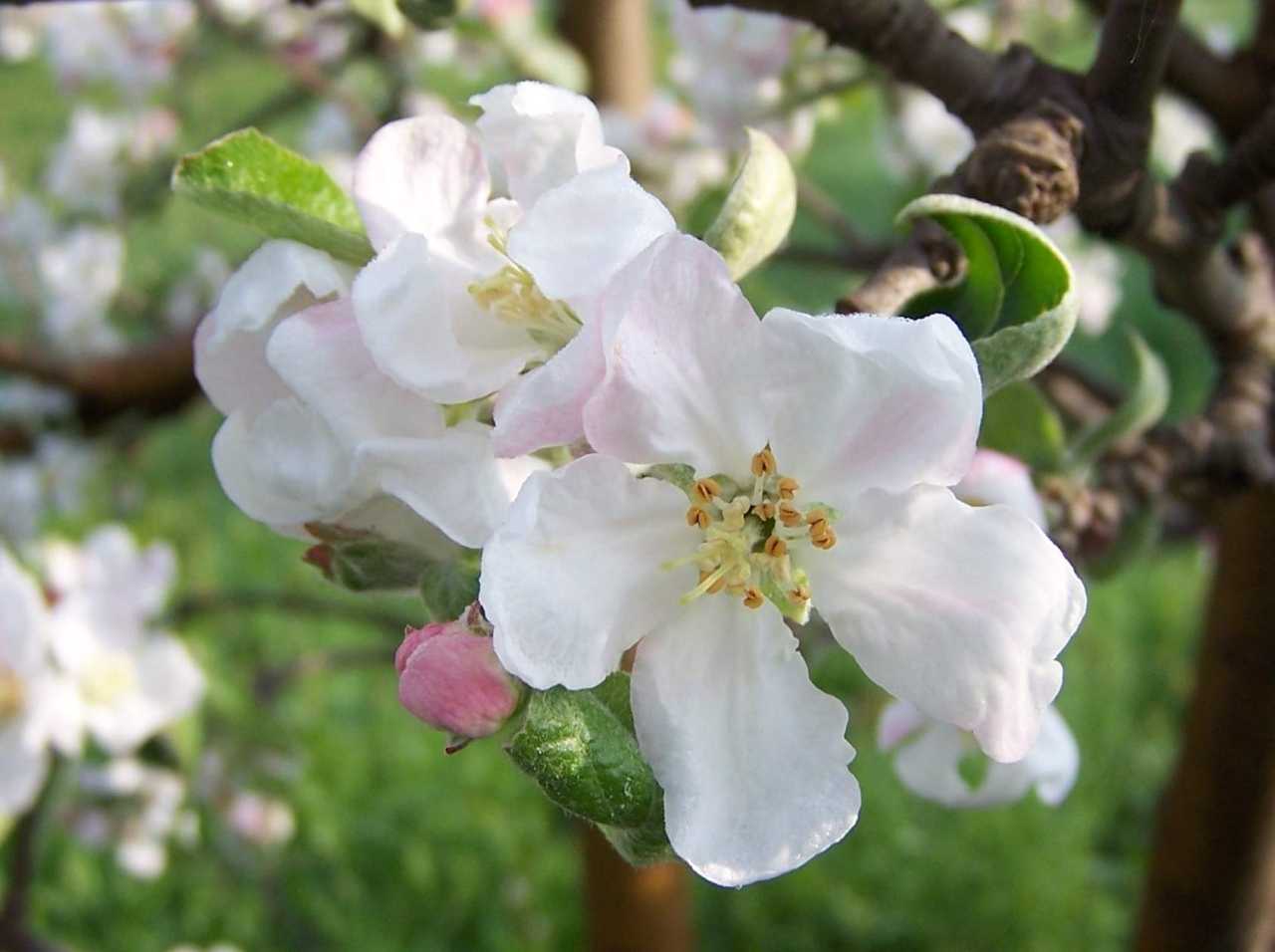
I was reading about apples from Michael Pollan's book "The Botany of Desire". On the left are some blossoms on an apple tree. What's really interesting about apples is that a plant grown from the seeds doesn't usually have the same characteristics as the parents. This results in apples having a large amount of variation, which is useful for the apple to survive in a wide variety of habitats. Today cultivators use methods like grafting to retain the features that we all love, with an unintended consequence being that the (domestic) apple has "stopped" evolving.
By Opioła Jerzy (Poland) - Own work, CC BY 2.5, https://commons.wikimedia.org/w/index.php?curid=772504 |
September 2023

|
Here's a photo of a red panda. I don't have much else to say except that in my opinion red pandas are the cutest mammals in existence.
Photo by Mathias Appel - Red Panda, CC0, https://commons.wikimedia.org/w/index.php?curid=53194723 |
August 2023

|
This is the thumbnail on Youtube for one of my favourite pieces of music: primeiro verão by Lilian Pinto. It means "first summer" in Portuguese and this has been a summer of many firsts for me and perhaps the world too. This has been my first summer as a proper adult with a job and responsibilities. This July there were so many many climate records broken that we're in for some drastic climate disasters that we have absolutely no control over. This was also a first monsoon with far fewer rains than I remember.
|
July 2023

|
Unfortunately, the rainy season hasn't been that rainy. A sign of times to come? On the left is pistachio fruits. The nut is dried before consumption and I was thinking about how we eat the seed itself, and not the fruit like in other fruits. That made me realize that I have never seen pistachio fruits. This is what they look like. It grows in arid regions and can live up to 300 years!
By Safa.daneshvar - Own work, CC BY-SA 3.0, https://commons.wikimedia.org/w/index.php?curid=32530487 |
June 2023
|
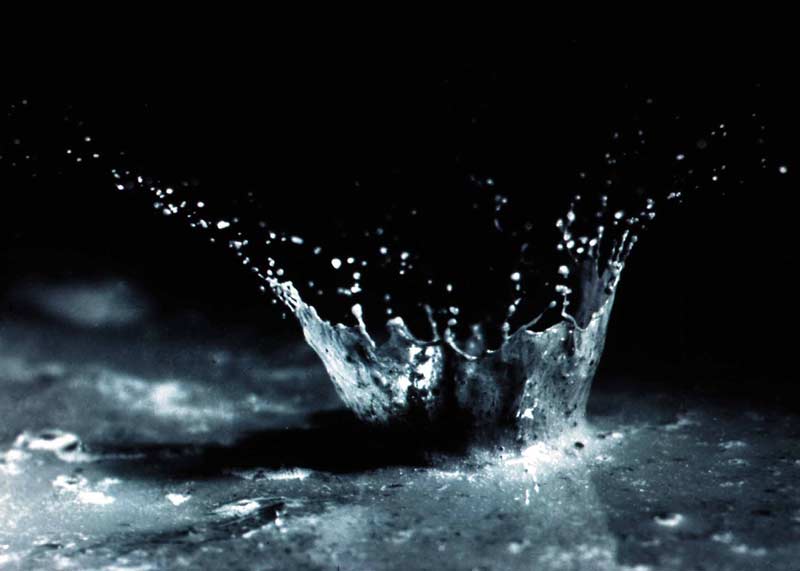
I'm back home and monsoon is right around the corner. Petrichor (from Greek) is the word for the scent of rain on dry soil. It's a really nice scent. It is produced when rain causes the release of certain aerosols that carry the chemical geosmin which is responsible for the scent. It is believed that camels rely on petrichor to locate oases!
By US Department of Agriculture - WEPP 95 CD-ROM, see http://www.ars.usda.gov/News/docs.htm?docid=18073, Public Domain |
May 2023

|
On the left is a groundhog preparing its nest for hibernation. The northern hemisphere is warming up and a lot of bats, groundhogs and bears would be waking up from their long winter slumber. Interestingly, ectothermic creatures like reptiles and amphibians cannot hibernate but instead show some dormancy (brumation). Some birds exihibit (involuntarily) lowered activity (torpor). It's all triggered by seasonal cues and their biology. Would they too think to themselves "just 5 more minutes"?
Photo by Cephas - Own work, CC BY-SA 4.0, https://commons.wikimedia.org/w/index.php?curid=79562856 |
April 2023

|
On the left is an illustration of baleen hair. The baleen plate is a clever mechanism that enables whales to take in a lot of water and filter it out through this comb-like structure leaving behind small creatures like krill (which the whales eat). I think it's pretty cool. There's an animation in the movie "Finding Nemo" by Pixar Studios. There's this song called "Baleen Morning" by Balmorhea that led me to look up the word.
Illustration from "On The Genesis of Species" by St. George Mivart, F.R.S. (1827-1900.) London: Macmillan and Co. 1871. Public Domain. |
March 2023
|
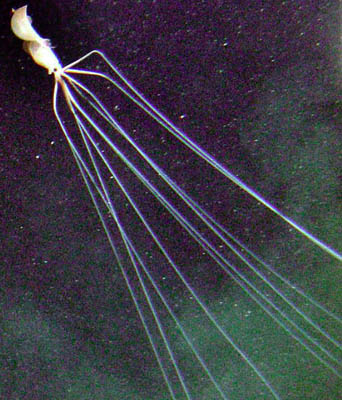
This month I'd like to bring attention to the Bigfin squid and more generally, deep sea creatures. This (genus of) species on the left is so rare that we only have a handful of sightings and we aren't even sure about it's full size (it's tentacles are believed to grow up to 8m in length) as an adult nor do we know about its feeding habits or how it eats even! It's really fascinating how these creatures have evolved at such depths and darkness and how little we know about them. In a way, the depths of the ocean is an alien world compared to the surface.
Picture by NOAA - http://www.tolweb.org/Magnapinna, Public Domain, https://commons.wikimedia.org/w/index.php?curid=8831608 |
February 2023
|
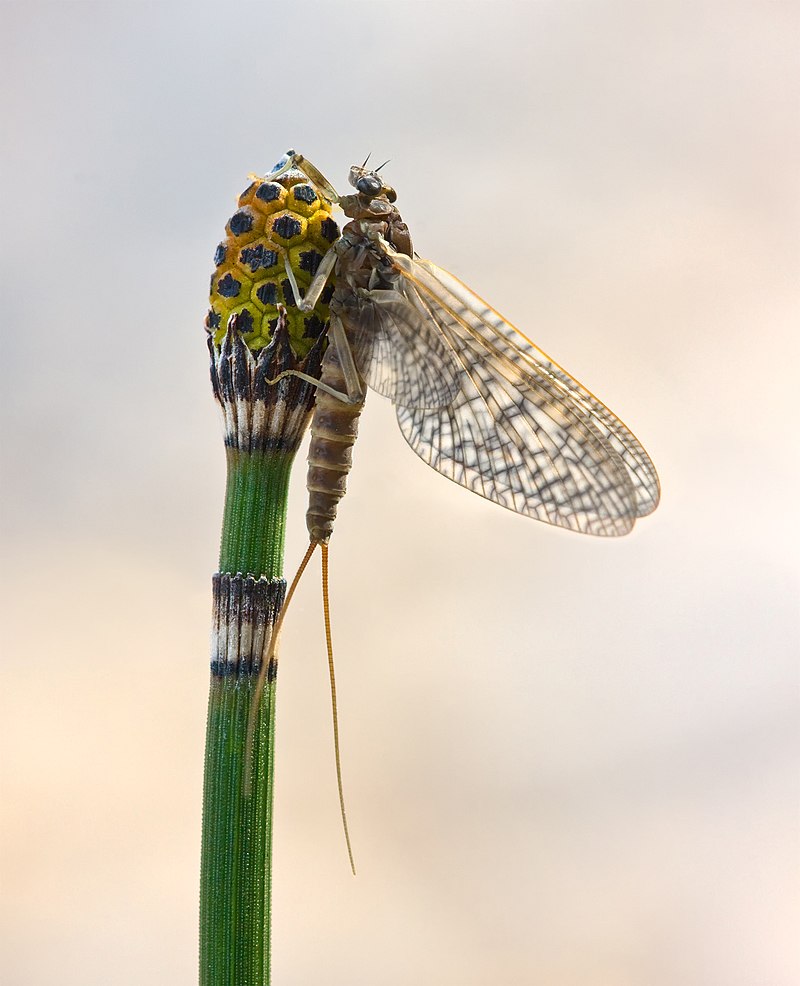
Last month's picture was that of one of the oldest living things, so this month I chose something on the other end: the mayfly. It's lifespan has three stages, the larval nymph stage lasting about 1 year to several years depending on the species, the intermediate subimago stage that lasts a few minutes to a couple of days and the imago or adult stage where they are mature and can fly, but the primary purpose is reproduction. The adult stage is very short (typically less than a day) and the adult females of Dolania americana lives for less than 5 minutes. It is strange and fascinating how this species has survived for as long as it has.
By Richard Bartz, Munich aka Makro Freak Image:MFB.jpg - Own work, CC BY-SA 2.5, https://commons.wikimedia.org/w/index.php?curid=6221193
|
January 2023

|
Another year has passed. Days (rotation of the earth), months (lunar cycles), years (seasons) are somewhat natural; hours, minutes, weeks etc. are man-made units. On the left is a picture (from Wikimedia Commons) of the Metuselah tree which is the oldest (non-clonal) living thing (known). It has seen 5000 summers go by, many full moons and droughts and meteor showers. Fortunately, it can't think (like us), else (I imagine) it would have been unbearably boring to just stand in a Californian desert for millennia.
By TiggyPop - Own work, CC BY-SA 4.0, https://commons.wikimedia.org/w/index.php?curid=92820254
|
December 2022

|
December is a snowy month in the Northern hemisphere (in countries where it snows; elsewhere it's just cold) and also happens to be the month I was born on. To the left is a GIF of the iterations of what's called a Koch curve or Koch snowflake. The actual Koch snowflake is the "limit" of these iterations. This is an example of a fractal or a self similar image in the sense that if you zoom into any small part, it looks like the bigger part. What's interesting about the Koch snowflake is that it bounds a finite area, but has infinite perimeter. The GIF is borrowed from Wikimedia Commons.
|
November 2022

|
The front page of The Guardian from October 28 2022. "On the day that Shell reports another round of bumper profits, and UK temperatures hit 20C in October, the UN finds there is 'no credible way' to keep to the 1.5C climate target". Towards the bottom right it says that the Meta (parent company of Facebook) shares lost 25% value and the bottom row is about an interview with actor Bill Nighy and a ranking of Jennifer Lawrence's films.
|